24 November 2026
Which plate details can make a vehicle fail a visual roadworthiness check?
Presented by @everydaymotoring
When a number plate fails the visual check
Every vehicle on UK roads must display a number plate that meets legal standards. During a visual roadworthiness check - whether at an MOT test, a roadside stop by police, or a dedicated inspection - the examiner looks at the plate itself, not just the vehicle around it. Many drivers assume that as long as the plate is fixed and readable, it will pass. In reality, several specific details can cause a failure, and they are often things people overlook when ordering or fitting a replacement plate.
The rules are set out in the Road Vehicles (Display of Registration Marks) Regulations 2001 and are enforced by the Driver and Vehicle Licensing Agency (DVLA). The key point is that the plate must conform to British Standard BS AU 145e (or the later BS AU 145f for plates fitted after 1 September 2021). If any detail falls short of that standard, the vehicle can fail the visual check. Understanding what the examiner checks helps you avoid an unexpected failure.
Reflective background and character colour
A number plate is not just a piece of plastic with letters on it. The background must be a specific shade of reflective material: yellow for the rear plate and white for the front. The reflective background is a safety feature - it makes the plate visible in headlights at night. If the background is too pale, too dark, or has a non-standard tint, the plate fails. Likewise, the characters must be solid black (with a few narrow exceptions for vehicles over a certain age). Any other colour, or a shade that looks grey or faded, is a failure point.
Examiners also look for damage to the reflective layer. Scratches, peeling, bubbling, or areas where the reflective coating has worn away can make the plate illegible or reduce its reflectivity. Even a small patch of damage near a character may be enough to fail if it affects readability. The same applies to dirt or mud that obscures part of the plate - the vehicle should be clean before any inspection.
Character font, size, and spacing rules
The font on a number plate is not a matter of personal taste. The DVLA specifies a particular typeface - often called the Charles Wright font - that must be used for all plates fitted after 1 January 1973. The font has a distinctive shape: straight, even strokes, no serifs, and specific proportions for each letter and number. If a plate uses a different font - even one that looks similar at a glance - it will fail the visual check.
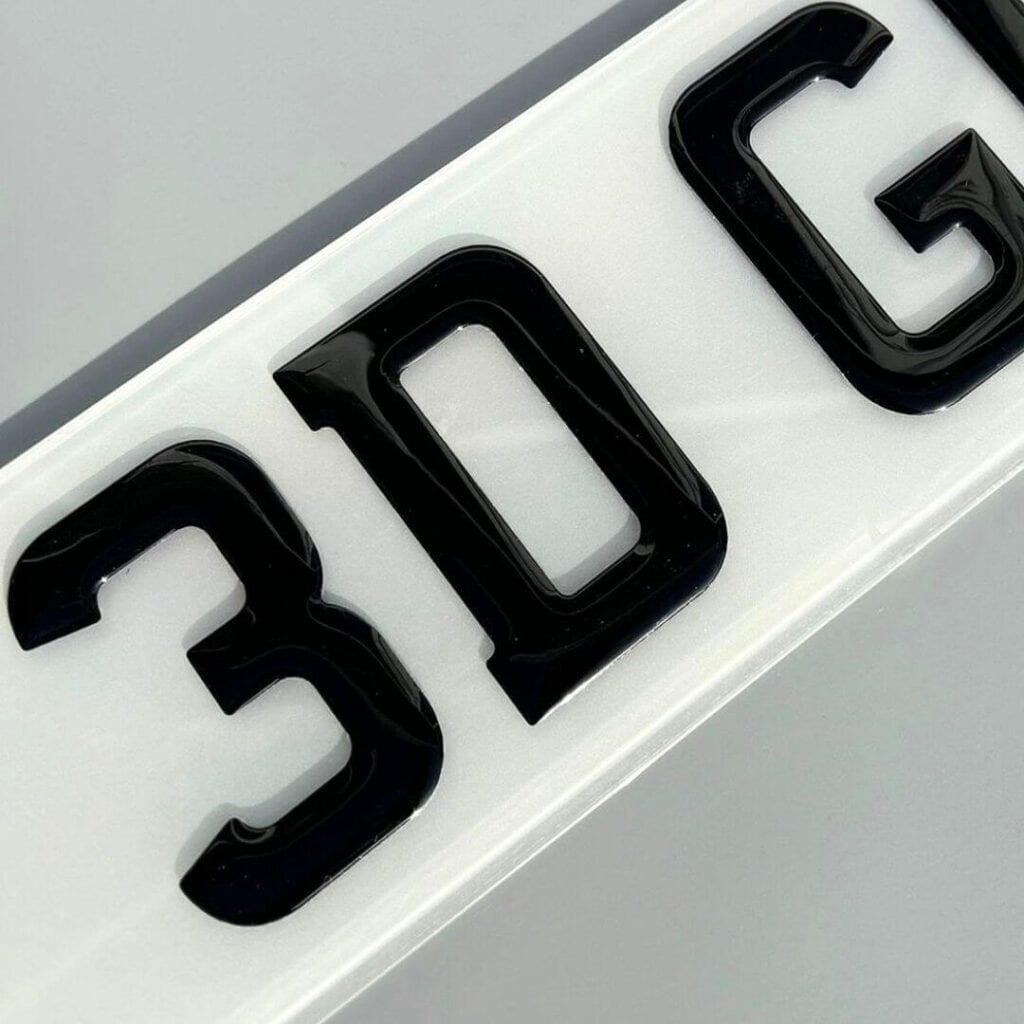
Character height must be 79 millimetres (except on certain older vehicles or imported models where a slightly smaller size is permitted). The width of each character (except the number 1) is 50 millimetres, and the stroke width is 14 millimetres. These dimensions are not negotiable. A plate with characters that are too tall, too short, or too narrow will not pass.
Spacing rules are equally strict. The gap between individual characters must be 11 millimetres. The gap between the group of letters and the group of numbers (the section that shows the age identifier) must be 33 millimetres. The margins around the characters - the space from the edge of the plate to the nearest character - must be at least 11 millimetres. If any of these spacing rules are broken, the plate is non-compliant. Even a plate that looks correct to the untrained eye can fail if the spacing is off by a few millimetres.
Manufacturer mark and British Standard mark
Every number plate sold in the UK must carry a manufacturer mark and a British Standard mark. The manufacturer mark shows who made the plate - it is a code assigned by the DVLA. The British Standard mark (BS AU 145e or BS AU 145f) shows that the plate meets the required standard. These marks are usually printed in a small strip at the bottom of the plate, along with the postcode of the supplying outlet. Without these marks, or if they are missing, incomplete, or illegible, the plate fails the visual check.
Some people buy cheap plates online or from unofficial sources and find that the marks are absent or fake. That is an instant failure. Even if the plate looks fine from a distance, the examiner will check for these marks. They are a legal requirement, not an optional extra.
Secure fixings and plate visibility
The plate must be securely fixed to the vehicle. Loose plates, plates held on with tape that has started to peel, or plates that rattle when the vehicle moves can all fail. The fixings themselves must not obscure any part of the characters. Some people use decorative screws or bolts with large heads that cover part of a letter or number - that is not allowed. The plate must be fully readable with nothing covering any character.
Visibility also means the plate must be mounted in the correct position. On the front, it must be on the vertical or near-vertical surface at the front of the vehicle, centred or on the offside (driver's side). On the rear, it must be on the vertical or near-vertical surface at the rear, again centred or on the offside. If the plate is angled, tilted, or fitted in a recess that makes it hard to read, the vehicle can fail. The plate must be clearly visible from the front or rear at a distance of 20 metres in daylight.

Font style and character shape
Beyond the basic font, the specific shape of each character matters. For example, the letter "O" and the number "0" must be distinguishable. The letter "I" and the number "1" must be different. Some fonts blur these distinctions, which causes a failure. Also, characters must not be italicised, bold, or condensed. They must be upright, standard weight, and evenly spaced. Any stylised version - such as a font that adds serifs, curves, or decorative tails - is not allowed.
This is a common trap for people who want a personalised plate. They choose a font that looks stylish but does not match the legal specification. The visual check picks that up immediately.
Plate age and condition
Plates that have faded, yellowed, or become brittle over time can fail. The reflective background must still reflect light evenly. If the plate has been on the vehicle for many years and the sun has dulled the surface, it may not meet the standard. Similarly, plates that are cracked, split, or have missing pieces are a clear failure. A plate that is held together with tape or glue is not acceptable.
Even a plate that was compliant when new can become non-compliant through wear and tear. That is why the visual check looks at the plate as it is on the day of inspection, not as it was when fitted.
The role of DVLA compliant plates in passing the check
When you order a new plate from a reputable supplier, the plate should meet all these requirements. But not all plates sold online are equal. Some suppliers cut corners on materials, use incorrect fonts, or omit the required marks. That is where the concept of DVLA compliant plates becomes important. A plate that is genuinely compliant will have the correct reflective background, the right font and spacing, and the required manufacturer and British Standard marks. It will be made from material that meets the standard and will be supplied with the documentation you need to prove compliance if asked.
Using DVLA compliant plates removes most of the guesswork. You still need to fit them correctly and keep them clean, but the plate itself will not be the reason your vehicle fails a visual check. The key is to buy from a supplier who understands the regulations and produces plates that match them exactly.

What to check before an inspection
Before a visual check, you can run through a simple list yourself. Look at the reflective background - is it the right colour and free from damage? Check the characters - are they solid black, the correct font, and evenly spaced? Make sure the manufacturer mark and British Standard mark are present and readable. Ensure the plate is securely fixed with no fixings covering any character. Clean the plate so it is fully visible. If any of these points are off, the plate is likely to fail.
If the plate is old or damaged, replacing it before the inspection is the safest approach. A new plate that meets the standard is inexpensive compared to the cost of a failed MOT or a fixed penalty notice for displaying incorrect plates.